Diverse 2.1.03.609 Gear Machining Methods, Customized on Demand
As the core component of mechanical transmission, the machining accuracy, efficiency, and cost of gears directly influence the performance of the entire machine. Gear machining methods need to be customized according to gear type, accuracy grade, production batch, and material properties. Below are the classifications, characteristics, and applicable scenarios of mainstream machining methods:
I. Forming Method (Profile Machining)
The forming method involves using a forming tool that exactly matches the shape of the gear tooth slot to directly machine the tooth surface, with the core principle being "replicating the tooth slot with the tool shape."
Gear Milling
Machining Principle: On an ordinary milling machine or a dedicated gear milling machine, a disc-shaped or finger-shaped forming milling cutter is used to mill the tooth slots of the gear blank one by one. After milling one tooth slot, indexing is performed before milling the next one.
Characteristics: Low equipment cost and simple operation, but low machining accuracy (tooth profile accuracy is generally IT11-IT9), low efficiency, and poor surface roughness.
Applicable Scenarios: Single-piece or small-batch production of low-speed gears with low accuracy requirements (such as manual machinery and simple transmission devices).Gear Broaching
Machining Principle: Using a specially made gear broach, all tooth slots are broached in one pass without indexing.
Characteristics: Extremely high machining efficiency and small surface roughness, but the manufacturing cost of the broach is expensive, and it can only machine internal gears or external gears of specific specifications.
Applicable Scenarios: Mass production of internal gears and standardized gears with medium accuracy requirements.
II. Generating Method (Generation Machining)
The generating method is based on the principle of gear meshing, where the tool and the workpiece simulate the meshing motion of a pair of gears to gradually cut the tooth surface. This method can produce high-precision involute tooth profiles and is currently the mainstream process for gear machining.
Gear Hobbing
Machining Principle: Using a hob as the tool, the hob and the workpiece perform rotational motions (generating motion) respectively, while the hob performs a feeding motion along the axis of the workpiece to continuously cut all tooth slots.
Characteristics: High machining efficiency, capable of machining straight and helical cylindrical gears with accuracy up to IT8-IT6, high versatility, and moderate equipment cost.
Applicable Scenarios: Medium- to large-batch production of straight and helical cylindrical gears, serving as the core machining process in industries such as automotive, machine tools, and reducers.Gear Shaping
Machining Principle: Using a gear shaper cutter as the tool, the gear shaper cutter and the workpiece perform meshing rotational motions (generating motion), while the gear shaper cutter performs an up-and-down reciprocating cutting motion to machine the tooth surface.
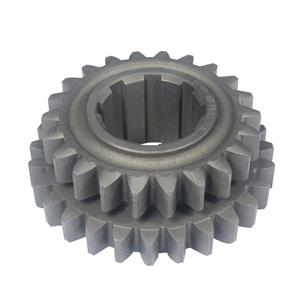
Characteristics: Capable of machining gears that are difficult to machine by hobbing, such as internal gears, double-gears, and multi-gears, with accuracy up to IT8-IT6 and uniform tooth surface quality.
Applicable Scenarios: Mass production of internal gears and double/multi-gears, as well as chamfering of gear tooth ends.Gear Grinding
Machining Principle: Using a grinding wheel as the tool, the tooth surface of the gear is ground through generating motion, belonging to a precision finishing process.
Characteristics: Extremely high machining accuracy (up to IT5-IT3) and minimal surface roughness (Ra0.8-Ra0.2), but high equipment cost and low machining efficiency.
Applicable Scenarios: Finishing of high-precision, high-speed, and heavy-duty gears (such as aero-engine gears, high-speed machine tool spindle gears, and precision reducer gears).Gear Honing
Machining Principle: The honing wheel and the workpiece perform free meshing motion, and the tooth surface is finished through the elastic deformation and abrasive cutting action of the honing wheel.
Characteristics: Effective in reducing tooth surface roughness and correcting minor tooth profile errors, with a gentle machining process that does not produce thermal deformation.
Applicable Scenarios: Finishing of quenched gears, replacing some gear grinding processes to reduce production costs.
III. Special Machining Methods
For gears made of difficult-to-machine materials (such as cemented carbide and ceramics) or with special structures, non-traditional special machining methods are required.
Electrical Discharge Machining (EDM)
Machining Principle: Utilizing electrical discharge between the electrode and the workpiece to erode and remove metal material, thereby machining the tooth profile.
Characteristics: Not limited by material hardness, capable of machining quenched steel and cemented carbide gears, but low machining efficiency and accuracy affected by electrode wear.
Applicable Scenarios: Machining of gears made of difficult-to-machine materials and precision mold gears.Laser Machining
Machining Principle: Using a high-energy laser beam to melt or vaporize the material of the gear blank, directly forming the tooth surface.
Characteristics: Fast machining speed, non-contact and stress-free, capable of machining complex tooth profiles, but high equipment cost and accuracy to be improved.
Applicable Scenarios: Rapid prototyping of thin-walled gears and micro-gears, as well as surface strengthening treatment of gears.
IV. Core Principles for Customizing Machining Solutions According to Requirements
Select Process Based on Accuracy: Choose gear milling for low-speed, low-accuracy gears; gear hobbing/shaping for medium-accuracy gears; and gear grinding/honing for high-precision, high-speed gears.
Select Process Based on Batch Size: Choose gear milling for single-piece or small-batch production; gear hobbing/shaping for medium- to large-batch production; and gear broaching for large-batch standardized gears.
Select Process Based on Structure: Choose gear shaping for internal gears and double-gears; gear hobbing for straight and helical cylindrical gears; and special machining methods for micro-gears and gears made of difficult-to-machine materials.