Types of Gears
Types of Gears
Gears are essential components in mechanical power transmission, transferring motion and torque through tooth engagement. Based on their structure, application, and transmission method, gears can be classified into various types. Below are the main categories and their characteristics:
1. Classification by Tooth Profile Shape
Involute Gears
Characteristics: Tooth profile is an involute curve, ensuring a constant transmission ratio during meshing. Easy to manufacture (commonly using hobbing or shaping processes) and widely used.
Applications: Automotive transmissions, machine tools, reducers, and most mechanical drives.
Cycloidal Gears
Characteristics: Tooth profile is a cycloid, offering high contact ratio and smooth transmission but requiring complex machining.
Applications: Watches, precision instruments, and low-speed, high-precision drives.
Circular Arc Gears
Characteristics: Tooth profile is a circular arc, providing high load-bearing capacity but demanding high manufacturing precision.
Applications: Heavy-duty machinery (e.g., rolling mills, mining equipment).
2. Classification by Tooth Orientation
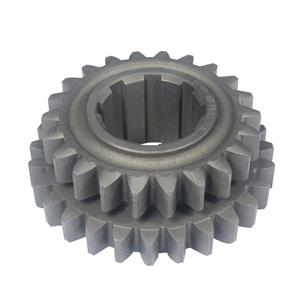
Spur Gears
Characteristics: Teeth are parallel to the axis, featuring a simple structure but prone to impact and noise during operation.
Applications: Low-speed, light-load drives (e.g., manual transmissions).
Helical Gears
Characteristics: Teeth are inclined to the axis, ensuring smooth transmission and high load capacity but generating axial thrust.
Applications: High-speed, heavy-load drives (e.g., automotive differentials, machine tool spindles).
Double Helical Gears (Herringbone Gears)
Characteristics: Composed of two symmetrical helical gears, canceling axial thrust and offering extremely high load capacity.
Applications: Large machinery (e.g., ship propulsion systems, power generators).
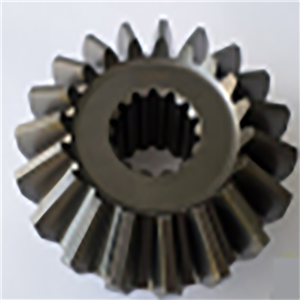
Straight Bevel Gears
Characteristics: Teeth are distributed along a conical surface for intersecting-axis drives but produce significant noise.
Applications: Automotive differentials, machine tool angle drives.
Spiral Bevel Gears
Characteristics: Teeth are helical, providing smooth transmission and low noise but requiring complex machining.
Applications: Automotive rear axle final drives, aerospace engines.
3. Classification by Gear Structure
Cylindrical Gears
Characteristics: Teeth are distributed on a cylindrical surface, including spur, helical, and double helical types.
Applications: Parallel-axis drives (e.g., reducers, gearboxes).
Bevel Gears
Characteristics: Teeth are distributed on a conical surface for intersecting-axis drives.
Applications: Automotive differentials, machine tool angle drives.
Non-Circular Gears
Characteristics: Pitch circle is non-circular, enabling a variable transmission ratio according to a specific pattern.
Applications: Special machinery (e.g., textile machines, instruments).
Worm Gears
Characteristics: Consist of a worm (helical screw) and a worm wheel (helical gear), achieving high reduction ratios and self-locking.
Applications: Cranes, elevators, reducers.
Racks
Characteristics: Teeth are distributed along a straight line, meshing with gears to convert rotary motion into linear motion.
Applications: Machine tool guides, automation equipment.
4. Classification by Transmission Method
Parallel-Axis Gear Drives
Types: Spur gears, helical gears, double helical gears.
Characteristics: High transmission efficiency and simple structure.
Intersecting-Axis Gear Drives
Types: Straight bevel gears, spiral bevel gears.
Characteristics: Used for angular drives but generate significant noise.
Crossed-Axis Gear Drives
Types: Worm gears, hypoid gears.
Characteristics: Enable high reduction ratios or special angular drives.
5. Special-Purpose Gears
Planetary Gears
Characteristics: Comprise a sun gear, planet gears, and a ring gear, providing reduction, speed increase, or differential functions.
Applications: Automotive automatic transmissions, wind turbines.
Harmonic Drives
Characteristics: Use a flexible gear deformation for transmission, offering high precision and compact size.
Applications: Robotic joints, aerospace equipment.
Face Gears
Characteristics: Tooth surface is planar, meshing with cylindrical gears for special angular drives.
Applications: Helicopter transmission systems.
6. Classification by Material
Metal Gears
Materials: Steel, cast iron, copper alloys.
Characteristics: High strength and wear resistance, suitable for heavy-duty drives.
Non-Metal Gears
Materials: Plastics, nylon, rubber.
Characteristics: Low noise and lightweight, suitable for light-load, low-speed drives (e.g., toys, office equipment).
Summary
Gears are classified based on tooth profile, orientation, structure, transmission method, and material, with each type suited for specific applications. For example:
High-speed drives: Helical or spiral bevel gears are preferred.
Heavy-duty drives: Double helical or circular arc gears are ideal.
Special angular drives: Worm gears or face gears are commonly used.
Understanding gear classifications helps in selecting the appropriate type to optimize mechanical system performance and reliability.
This translation maintains technical accuracy while ensuring clarity for an English-speaking audience. Let me know if you'd like any refinements!